Saturday, August 14, 2010

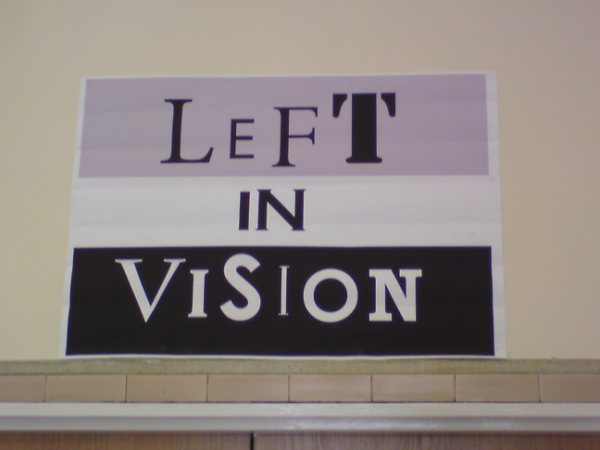
More Photos of Left in Vision 4

More photos from Left in Vision 4 courtesy of Dale Pattenden


Thursday, August 12, 2010

Photos from Left in Vision 4

A selection of photos from the Left in Vision 4 art show at Marxism 2010, courtesy of Nicola Field.


Corner Piece by Keith Robertson


The Tragedy of the Roma by Robb Waterfield


Tuesday, July 20, 2010

LEFT IN VISION 4 COMMENTS

LEFT IN VISION 4 – COMMENTS BOOK

Left in Vision 4 was a major success. Over 200 attended the Launch and we had to move to a bigger space. There was also a very high attendance of people throughout the five days. The show was very enthusiastically received as can be seen in the Comments Book below. Photographs to follow'

So a very big thank you to every one who contributed.


LEFT IN VISION 4 – COMMENTS BOOK


Even better than last year’s! I especially liked ol’ Benito!! Excellent, comrades!
Tim Evans


This is a show to Lift the Heart AS WELL AS the Politics!!
Maureen Delenian


Great selection – political – brilliant antidote to mainstream art – fantastic curation. Well done John
Deni xx

It’s even better than last year! A reflective, sharp atmosphere, inventive collection and sense of wild possibilities. The inner world interacts with the outer. Thanks to everyone, I especially love the leaning cabinet, the hanging effigies and the May Ayres ceramic sculpture.
Nicole Field


This is our first year here. Excellent exhibition.
Jon Bailes, Ethan Aksan, State of Nature Journal


Thank you for your exhibition. On my journey I start to think about anti-consumerism.
Onanong


Wonderful and complex.
Riaz Ahmed


What to write, as an art historian in training it’s refreshing to see art with an explicit left basis.
H

It’s great that art is seen as Marxism. Political art is an absolute necessity for a serious political organisation.
E.P

Amazing art:
Aja S from Macedonia

This is the best – well done
Fred from Swansea


Love the Red Saunders! and ‘All you fascists are bound to lose’.
(We’re from Bradford)

Fantastic work. I enjoyed lots thanks.

Excellent exhibitions – real quality. See you at the opening.
Sherrl

Excellent to see it. Hope the project continues.
Ken Devine

Very good work – loved it!
Isabel

Interesting show – great variety of work.
Ginny

May Ayres Ceramic ‘Pro- Consul’ - in a Socialist World would have pride of place in Tate Modern!

Great exhibition hope to see it in every Marxism.
Bassen
Lebanon

Very interesting and inspiring. I appreciate every effort made in creating such fantastic space.
Fouad
From Iraq

WOW – I will be back
Annie

Very stimulating
Connor Donnally

What we need the more painters and other can do it.

Very interesting, provocative. Thank you
Maria Emery

Excellent show, some really powerful works. Thank you

BRILLIANT! WE WANT THIS AGAIN!!

The work is better than ever – but not enough of it.
Gary Critchley -What an artist to emerge from that environment. Hope Left in Vision will carry on after John’s retirement. We owe it to him as a tribute for all he’s done.
Pauline

Excellent show – very stimulating and thought provoking.
Chris

Ditto
Leo

Very interesting and well curated show!
M. Wydler


It is wonderful art. All of it is talking in different ways.
Maher Deyab

Very interesting representation of lots of important and practical issues and social problems. Thank you
Ashraf Abdelhay


Interesting
Anthony

Interesting work overall, especially Zita and Antonietta’s work. Also John Levett’s photography is interesting.

Wonderful exhibition – need more art exhibitions displaying the work of Marx in the left. Thank you for including my art. Zeta
P.S. Would have liked to have seen Antonietta’s art on display not just in slides.

Well done guys!

Really love the work big up!

The Negroponte sculpture is just amazing. Thanks to everyone and particularly the great John Molyneux.
M.B.

Extremely good show.
Richie Peacock

A lovely show with the depths and breadths of the struggle. Good to have seen.
Gillian Noel

Great show – lots of variety and emotional – passionate. Thanks
E. Shirley

Fantastic!
Hans Pudner
South Wales

Very interesting, need to spend more time here. Thanks

Really enjoyed the quiet of looking around! So good to see here at Marxism!

Brilliant and enjoyable, very inspired by the Fascism 2010.

Very good – I like.
R McFarlane

Very well done once more.
Best wishes
Jenny Walden


Love it all thanks for great inspirational work.

Very nice, I always enjoy a wonky cupboard.


Thought provoking – especially sculpture
Chanie Rosenberg


Need to come and see the ‘Left in Vision’ again.

I enjoyeded this presentation, thought provoking. The video ‘Going Up North’ was lovely.
Thanks Brenda

Thanks, this was very enjoyable and engaging.

Some very distressing themes treated in a powerful way.
Many thanks
Mike Champion

Thought provoking, uplifting, interactive

Great to see Marxism in art. I only wish it wasn’t a focus once a year. Why can’t we take this further?
Anthony Elliott

I’m a film scholar and was really pleased to see you had an AV section – the film by the 8 year old is wonderful! But fantastic exhibition more generally too, as always.
S Bould

Inspiring pieces – and thought provoking. I liked many of them but Leon’s images was/is very powerful.
Chris Kelly

It just keeps getting better – love the many perspectives – very inspiring.
Jacqui Miller

For the future we must never forget the past horrors of injustice.
Gerry Conlon


Keep up the good work of displaying committed art work at Marxism.
Mike Stirland

A good experience as always. A bigger room next year?
Debbie Rolls

Loved the tit box, very interesting.

Thank you very much for this very touching and inspiring exhibition. There is a very brilliant mixture of art and artists in this exhibition leading to a wide range of emotion: fear, sorrow, fighting-spirit, a great deal of humour and … how can I call it … self-reflecting possibilities.
Frances,
Cologne, Germany

This exhibition is great – expresses a wide range of emotion.
Fantastic keep on keep on!

This exhibition is really impressive and it is fascinating the different styles of radical art displayed.
Sheila Rowbotham

Thought provoking – my thoughts exactly about bankers and on David and Nick.
Theresa
London

I enjoyed the exhibition very much
Jhoselin Loza

Very insightful and useful, hope you carry on the good work.
J

Love it Dale!
A Stennett
Birmingham

Great stuff – Art for resistance. That’s how it should be. I am so liberated as I don’t believe in capitalism.
Well done Zita. Love also the ‘Poverty’ sculpture and all.


A very informative and fantastically relevant exhibition. Hooray to Zita for her exhibits and Fred for ‘Marching to Freedom’. Brilliant anti fascist material here today.
MC

Thought provoking, politically diverse works of art which left me reeling, smiling and frowning.
Peace
Benita


Amazing
C. Campbell

Fantastic work.

Very skilled and beautiful work. May God (Lord Jesus Christ) come back soon and end all suffering as we repent.
Linda P

Very good and inspiring. More of this please!
Ammedy

Wonderful! Let there be more!

Lots of really invigorating art, especially when you consider how much dry and uncaring work gets out, gets paid millions for in the mainstream. Definitely enjoyed Fred Whitby’s agitprop.
Soren Goard

Thank you
Ella

Fantastic – thanks for organising this.

Such an important part of Marxism – bigger next year please!

Some brilliant stuff – lots of quality and range.
Martin Adams

I think when the works are engaged with the materiality of the injustice and crime, their ideas are better transformed and become more effective. Well done to the artist and organizers who worked for such a forgotten/ignored vision of the world.

An amazing exhibition really loved it; and looking forward to share such good sculpting, painting, installations. Just keep inspiring us!
Selma
NPR France

Moving, chilling and provocative – a great exhibitions.
S Magorian


Fantastic exhibition – especially The Gypsies. It reminded me of Van Gogh’s ‘Potato Eaters’ – lovely. The Hitler picture was also one of my favourites because it is so clear what he did and his crimes, and you have got him and pinned him against the wall. Love it. The other side with Nick Griffin too shows what a demented and backward thing he represents, in his face too. Brilliant. It is all good.
Am glad to have seen it this year at Marxism as I was initially very disappointed in not getting my stuff included. However, it was a good lesson in not being to precious about ones work and seeing the exhibition gave me a boost to think about starting to produce work again. This exhibition needs to visited at least three or four times as there is so much to see. Well done everyone – I loved it.
Sophie Jongman, Kent


Excellent, powerful, creative and thought provoking – a treat for the intellectual senses!!
Well done!!

Some of the pieces made me laugh, some made me want to cry and they all made me think.
Thank you
Sarah Cox

Needs to be more widely shown.

Please keep up the tradition or radical left art – we need it!
All the best.
Sadie, Australia

Very good. We need more lefty art. Keep it up.
Jim Roche (Irish Anti War Movement)

Sort of encapsulates a few thoughts I have – very creative.
S Elliott
Whitstable

More explicitly political than previous exhibitions – not necessarily better (or worse) but more a sign of the times. We need this work.

Great
Danielle Darby

Thank you. Interesting as always. Please come again next year.

Lovely

Fine and interesting exhibition.
Thomas W

Excellent

Excellent as always! I particularly like The Pro Consul
Penny Foskett

Could have done with more explanation from the artists of what they were trying to say – also mostly negative/horrific – could do with more hope.
David Hughes

Very interesting … quite a variety in a small exhibition.
Jan Friday


Long live revolutionary art.
Ian Birchall


I appreciated listening to the music while looking at the slideshow. Also like the ‘Footprints’ by Kim.
Jasmina


Some interesting work – good to see prisoners work on show. Like the theme of historical portraits of ‘our’ hero’s time to take them back.
Matt

Awesome, have one every year! More diversity and more descriptions/explanations the better. Have artist’s email too.
N

Fantastic, great work, would have liked more context or comment or just biography – it really helps to understand.
Thank you for all your hard work.
Andrew Smith

Even more wonderful than last year – keep on keeping on with it. Loved the gypsies.
Anna x

Good stuff – keep creating!
Ewa

I applaud the work and achievement. Quite a mixed bunch in terms of what ‘worked’ for me. As others have said more context would be helpful.
Look forward to next year’s!
Colin F

Thanks for an excellent show.
Leon Kuhn

Great to see work and comrades. Love Tony Cliff sculpture

Good job – keep up the good work.
Jon

Fantastic show, please repeat next year!
N. Brute

It’s not really about liking us, not liking, but I’ll say that what excited me were the sculptures rather than the photos/drawings/paintings.
Please come back next year (maybe even with art that is not just built in spectatorship but on interaction or participation as well)!

Viva La Revolution
Patrick

Nice stuff! We need more of this.
Phoebe

Fabulous to have this here!
Ian

Dear John
Thank you for your brilliant lecture on Michelangelo and for one of those who organised the exhibition ‘Left in Vision’.
Yes, art can change things yes, art can be revolutionary and yes, together with other factions art can make socialism!
Ivor Jordre, Marxist and painter, Norway.

Really great to see how this show has developed over the years with all this interesting work. Keep it up!
Penny

Brilliant exhibit! A superb collection of works that I feel are sadly not very likely to be collected elsewhere. It would be wonderful to have a ‘Left of Vision’ webpage where we could share these works with more people throughout the course of the year.
Thank you
Joshua, Glasgow

Great Art

Dear John
One passed by.


Now, I thought it was going to be pretentious student toss but it was great! The Fred Whitby ‘Marching to Freedom’ is amazing.
Well done.
Marcus

A stunning exhibition, witty, thought provoking
Well done John
Hannah

John Thanx for all your hard work.
Mick Lynes

Many, many thanks John for another wonderful show.
May

Excellent show, very impressed with the range of work and the imagination expressed.
Ian S

Very impressive!!
Alexander Ling


Even better than last year’s! I especially liked ol’ Benito!! Excellent, comrades!
Tim Evans


This is a show to Lift the Heart AS WELL AS the Politics!!
Maureen Delenian


Great selection – political – brilliant antidote to mainstream art – fantastic curation. Well done John
Deni xx

It’s even better than last year! A reflective, sharp atmosphere, inventive collection and sense of wild possibilities. The inner world interacts with the outer. Thanks to everyone, I especially love the leaning cabinet, the hanging effigies and the May Ayres ceramic sculpture.
Nicole Field


This is our first year here. Excellent exhibition.
Jon Bailes, Ethan Aksan, State of Nature Journal


Thank you for your exhibition. On my journey I start to think about anti-consumerism.
Onanong


Wonderful and complex.
Riaz Ahmed


What to write, as an art historian in training it’s refreshing to see art with an explicit left basis.
H

It’s great that art is seen as Marxism. Political art is an absolute necessity for a serious political organisation.
E.P

Amazing art:
Aja S from Macedonia

This is the best – well done
Fred from Swansea


Love the Red Saunders! and ‘All you fascists are bound to lose’.
(We’re from Bradford)

Fantastic work. I enjoyed lots thanks.

Excellent exhibitions – real quality. See you at the opening.
Sherrl

Excellent to see it. Hope the project continues.
Ken Devine

Very good work – loved it!
Isabel

Interesting show – great variety of work.
Ginny

May Ayres Ceramic ‘Pro- Consul’ - in a Socialist World would have pride of place in Tate Modern!

Great exhibition hope to see it in every Marxism.
Bassen
Lebanon

Very interesting and inspiring. I appreciate every effort made in creating such fantastic space.
Fouad
From Iraq

WOW – I will be back
Annie

Very stimulating
Connor Donnally

What we need the more painters and other can do it.

Very interesting, provocative. Thank you
Maria Emery

Excellent show, some really powerful works. Thank you

BRILLIANT! WE WANT THIS AGAIN!!

The work is better than ever – but not enough of it.
Gary Critchley -What an artist to emerge from that environment. Hope Left in Vision will carry on after John’s retirement. We owe it to him as a tribute for all he’s done.
Pauline

Excellent show – very stimulating and thought provoking.
Chris

Ditto
Leo

Very interesting and well curated show!
M. Wydler


It is wonderful art. All of it is talking in different ways.
Maher Deyab

Very interesting representation of lots of important and practical issues and social problems. Thank you
Ashraf Abdelhay


Interesting
Anthony

Interesting work overall, especially Zita and Antonietta’s work. Also John Levett’s photography is interesting.

Wonderful exhibition – need more art exhibitions displaying the work of Marx in the left. Thank you for including my art. Zeta
P.S. Would have liked to have seen Antonietta’s art on display not just in slides.

Well done guys!

Really love the work big up!

The Negroponte sculpture is just amazing. Thanks to everyone and particularly the great John Molyneux.
M.B.

Extremely good show.
Richie Peacock

A lovely show with the depths and breadths of the struggle. Good to have seen.
Gillian Noel

Great show – lots of variety and emotional – passionate. Thanks
E. Shirley

Fantastic!
Hans Pudner
South Wales

Very interesting, need to spend more time here. Thanks

Really enjoyed the quiet of looking around! So good to see here at Marxism!

Brilliant and enjoyable, very inspired by the Fascism 2010.

Very good – I like.
R McFarlane

Very well done once more.
Best wishes
Jenny Walden


Love it all thanks for great inspirational work.

Very nice, I always enjoy a wonky cupboard.


Thought provoking – especially sculpture
Chanie Rosenberg


Need to come and see the ‘Left in Vision’ again.

I enjoyeded this presentation, thought provoking. The video ‘Going Up North’ was lovely.
Thanks Brenda

Thanks, this was very enjoyable and engaging.

Some very distressing themes treated in a powerful way.
Many thanks
Mike Champion

Thought provoking, uplifting, interactive

Great to see Marxism in art. I only wish it wasn’t a focus once a year. Why can’t we take this further?
Anthony Elliott

I’m a film scholar and was really pleased to see you had an AV section – the film by the 8 year old is wonderful! But fantastic exhibition more generally too, as always.
S Bould

Inspiring pieces – and thought provoking. I liked many of them but Leon’s images was/is very powerful.
Chris Kelly

It just keeps getting better – love the many perspectives – very inspiring.
Jacqui Miller

For the future we must never forget the past horrors of injustice.
Gerry Conlon


Keep up the good work of displaying committed art work at Marxism.
Mike Stirland

A good experience as always. A bigger room next year?
Debbie Rolls

Loved the tit box, very interesting.

Thank you very much for this very touching and inspiring exhibition. There is a very brilliant mixture of art and artists in this exhibition leading to a wide range of emotion: fear, sorrow, fighting-spirit, a great deal of humour and … how can I call it … self-reflecting possibilities.
Frances,
Cologne, Germany

This exhibition is great – expresses a wide range of emotion.
Fantastic keep on keep on!

This exhibition is really impressive and it is fascinating the different styles of radical art displayed.
Sheila Rowbotham

Thought provoking – my thoughts exactly about bankers and on David and Nick.
Theresa
London

I enjoyed the exhibition very much
Jhoselin Loza

Very insightful and useful, hope you carry on the good work.
J

Love it Dale!
A Stennett
Birmingham

Great stuff – Art for resistance. That’s how it should be. I am so liberated as I don’t believe in capitalism.
Well done Zita. Love also the ‘Poverty’ sculpture and all.


A very informative and fantastically relevant exhibition. Hooray to Zita for her exhibits and Fred for ‘Marching to Freedom’. Brilliant anti fascist material here today.
MC

Thought provoking, politically diverse works of art which left me reeling, smiling and frowning.
Peace
Benita


Amazing
C. Campbell

Fantastic work.

Very skilled and beautiful work. May God (Lord Jesus Christ) come back soon and end all suffering as we repent.
Linda P

Very good and inspiring. More of this please!
Ammedy

Wonderful! Let there be more!

Lots of really invigorating art, especially when you consider how much dry and uncaring work gets out, gets paid millions for in the mainstream. Definitely enjoyed Fred Whitby’s agitprop.
Soren Goard

Thank you
Ella

Fantastic – thanks for organising this.

Such an important part of Marxism – bigger next year please!

Some brilliant stuff – lots of quality and range.
Martin Adams

I think when the works are engaged with the materiality of the injustice and crime, their ideas are better transformed and become more effective. Well done to the artist and organizers who worked for such a forgotten/ignored vision of the world.

An amazing exhibition really loved it; and looking forward to share such good sculpting, painting, installations. Just keep inspiring us!
Selma
NPR France

Moving, chilling and provocative – a great exhibitions.
S Magorian


Fantastic exhibition – especially The Gypsies. It reminded me of Van Gogh’s ‘Potato Eaters’ – lovely. The Hitler picture was also one of my favourites because it is so clear what he did and his crimes, and you have got him and pinned him against the wall. Love it. The other side with Nick Griffin too shows what a demented and backward thing he represents, in his face too. Brilliant. It is all good.
Am glad to have seen it this year at Marxism as I was initially very disappointed in not getting my stuff included. However, it was a good lesson in not being to precious about ones work and seeing the exhibition gave me a boost to think about starting to produce work again. This exhibition needs to visited at least three or four times as there is so much to see. Well done everyone – I loved it.
Sophie Jongman, Kent


Excellent, powerful, creative and thought provoking – a treat for the intellectual senses!!
Well done!!

Some of the pieces made me laugh, some made me want to cry and they all made me think.
Thank you
Sarah Cox

Needs to be more widely shown.

Please keep up the tradition or radical left art – we need it!
All the best.
Sadie, Australia

Very good. We need more lefty art. Keep it up.
Jim Roche (Irish Anti War Movement)

Sort of encapsulates a few thoughts I have – very creative.
S Elliott
Whitstable

More explicitly political than previous exhibitions – not necessarily better (or worse) but more a sign of the times. We need this work.

Great
Danielle Darby

Thank you. Interesting as always. Please come again next year.

Lovely

Fine and interesting exhibition.
Thomas W

Excellent

Excellent as always! I particularly like The Pro Consul
Penny Foskett

Could have done with more explanation from the artists of what they were trying to say – also mostly negative/horrific – could do with more hope.
David Hughes

Very interesting … quite a variety in a small exhibition.
Jan Friday


Long live revolutionary art.
Ian Birchall


I appreciated listening to the music while looking at the slideshow. Also like the ‘Footprints’ by Kim.
Jasmina


Some interesting work – good to see prisoners work on show. Like the theme of historical portraits of ‘our’ hero’s time to take them back.
Matt

Awesome, have one every year! More diversity and more descriptions/explanations the better. Have artist’s email too.
N

Fantastic, great work, would have liked more context or comment or just biography – it really helps to understand.
Thank you for all your hard work.
Andrew Smith

Even more wonderful than last year – keep on keeping on with it. Loved the gypsies.
Anna x

Good stuff – keep creating!
Ewa

I applaud the work and achievement. Quite a mixed bunch in terms of what ‘worked’ for me. As others have said more context would be helpful.
Look forward to next year’s!
Colin F

Thanks for an excellent show.
Leon Kuhn

Great to see work and comrades. Love Tony Cliff sculpture

Good job – keep up the good work.
Jon

Fantastic show, please repeat next year!
N. Brute

It’s not really about liking us, not liking, but I’ll say that what excited me were the sculptures rather than the photos/drawings/paintings.
Please come back next year (maybe even with art that is not just built in spectatorship but on interaction or participation as well)!

Viva La Revolution
Patrick

Nice stuff! We need more of this.
Phoebe

Fabulous to have this here!
Ian

Dear John
Thank you for your brilliant lecture on Michelangelo and for one of those who organised the exhibition ‘Left in Vision’.
Yes, art can change things yes, art can be revolutionary and yes, together with other factions art can make socialism!
Ivor Jordre, Marxist and painter, Norway.

Really great to see how this show has developed over the years with all this interesting work. Keep it up!
Penny

Brilliant exhibit! A superb collection of works that I feel are sadly not very likely to be collected elsewhere. It would be wonderful to have a ‘Left of Vision’ webpage where we could share these works with more people throughout the course of the year.
Thank you
Joshua, Glasgow

Great Art

Dear John
One passed by.


Now, I thought it was going to be pretentious student toss but it was great! The Fred Whitby ‘Marching to Freedom’ is amazing.
Well done.
Marcus

A stunning exhibition, witty, thought provoking
Well done John
Hannah

John Thanx for all your hard work.
Mick Lynes

Many, many thanks John for another wonderful show.
May

Excellent show, very impressed with the range of work and the imagination expressed.
Ian S

Very impressive!!
Alexander Ling

Towards a Democratic University

TOWARDS A DEMOCRATIC UNIVERSITY

This article was first written for The Heckler, the magazine of Portsmouth University UCU branch. It therefore refers specifically to the situation in Portsmouth Uni but clearly its arguments are generalizable to other institutions. If anyone wants to take up those arguments or adapt this text to their situation please feel free to plagiarize shamelessly.


On May 6 we in Britain elected a new government. The process was rather messy and confused, which is not surprising given the nature of the British electoral system. Nevertheless the election took place and a new government emerged. The turnout was up, which took some returning officers by surprise but was generally regarded as a good thing, since it seems to be the prevailing attitude that it is our civic duty to exercise our vote. With the exception of a few very specific categories ( peers of the realm, criminals in prison etc) all adult citizens have the vote, a right which was very hard fought for over a long period in many campaigns (such those of the Chartists and the Suffragettes) but which is now taken for granted by more or less everyone. I know of NO political party or pressure group or even significant individual which says openly that it wishes to rescind this basic democratic right, or even curtail it. What would one think of someone today who proposed the government should be appointed by the Queen (without any election) or by the House of Lords, or wanted to remove the right to vote from, say, women or working class people?

Pretty much the same applies to the United States with difference that there the people directly elect an individual as President and that on November 4, 2008 this produced the historic victory, by a landslide, of Barack Obama; this being especially dramatic as the right to vote for black people was still being fought for in parts of America as late as the 1960s. Again what would one think of someone who suggested that the right to elect the President should be taken away, either from the US citizenry as a whole, or American women or people of colour?

WHY IS IT THEN THAT IN THIS UNIVERSITY WE DO NOT HAVE THE RIGHT TO ELECT OUR VICE CHANCELLOR? [OR OUR BOARD OF GOVERNORS, OR OUR FACULTY DEANS, OR OUR HEADS OF SCHOOL OR DEPARTMENTS?]

My experience is that when I ask this question it is generally assumed that I am joking, certainly not being serious. EVERYONE knows that’s not possible – we just don’t do things like that. If I put the question to people in positions of authority in the University they generally do not even deem it worthy of a response. Which is convenient because it is very hard to formulate a response which is not at the same time an argument against democracy in general, an argument against, for example, the right to elect the government.

For instance, the most obvious argument against electing the Vice Chancellor is that it would be likely to lead to the wrong person getting elected. The absurdity of this proposition becomes manifest the moment you apply it to British parliamentary or US presidential elections. If you are a supporter of either the Labour Party or the Conservative Party, the wrong party gets elected about half the time in Britain, likewise if you are a Republican or a Democrat in the US. If you are a Liberal Democrat or a radical Socialist, or a Green or a fascist, the wrong party or leader gets elected pretty much all the time. But unless you are a fascist this is not a reason for getting rid of elections.

Sometimes it is argued that the reason why the wrong people get elected is that the electors are not capable (too stupid, too uneducated, too immature, too fickle etc) of making the right judgement. This, of course, was the kind of argument advanced against giving the vote to working people in the 19th century, to women before the First World War, to women under 30 between 1918 and 1928, and to black people in South Africa under apartheid. It is, however, a rather difficult argument to defend in a university.

If, on the other hand, we actually had an election for Vice Chancellor the incompetence of the electors argument might come into play in determining the franchise in this election. Personally, I would favour voting rights only for male academics with PhDs. I joke; the important thing would be to restrict voting to academic staff and exclude the support staff who are mainly female, I mean less well educated. Or perhaps the white collar support staff could be included, so long as the really working class riff-raff like caretakers, canteen staff and cleaners were kept out. Actually, I suppose – if all that sounds a bit elitist, or sexist, or classist, or politically incorrect – ALL university employees could be allowed to vote, on one condition – no votes for students. Obviously students are too young, too inexperienced, too uneducated, and too volatile to be allowed to vote in parliamentary…I mean university elections.

In this context it is interesting to note that, just as the present parliamentary systems in Britain, the US, and France, all owe their existence to very unparliamentary wars and revolutions, so the present unelected Vice Chancellor actually owes his position, at least in part, to a vote: namely the vote of no confidence that unseated his predecessor, Neil Merritt, in which EVERY university employee had a vote. It is also worth noting that ONE section of the University community does govern itself relatively democratically, and does elect its leaders, locally and nationally, and that is the Students’ Union.

I really hope that someone who is opposed to the idea of democratically electing the University’s leading figures replies to this article – in fact I challenge them to do so – and in that reply I hope they explain why it would be wrong to elect VCs (and deans etc) but possible, nay mandatory, for the Students’ Union to elect its President. Or perhaps they would like to argue that the student president should be appointed (by the Directorate perhaps, or maybe by the Board of Governors). But, of course, one of the ironies of the situation is that because those who run the University are not subject to any real democratic accountability, they do not need to justify their position in democratic debate, but can simply ignore these arguments relying on their undemocratic power to preserve the status quo.

An argument that might be used by an astute opponent is that elections would ‘politicise’ the running of the University and that it would be much better for the University to remain ‘non- political’. This argument is superficially attractive because it appeals to popular (and entirely understandable) hostility to ‘politics’ and ‘politicians’ but in reality it is completely specious. First it relies on the very narrow, and false, definition of ‘politics’ as limited only to what goes on in the Palace of Westminster and City Hall, and ‘politicians’ as only elected MPs and Councillors. Second it fails to recognise that the running of this and every other university is already deeply political and could not be otherwise – the ability to present decisions and institutional structures as non-political is really just testimony to their political hegemony, in the same way that the ability to present ideas as ‘just common sense’ as opposed to ‘political’ or ‘ideological’ is merely evidence of their deep political and ideological hold. For example the belief that the free market is the best way to run society is presented by its adherents as ‘common sense’ but its acceptance as such represents a very important victory for a definite political ideology, namely right wing neo- liberalism. A system of appointment, as we have at present, is every bit as ‘political’ as a system of election, it’s just a different undemocratic politics. Finally, and I keep coming back to this, if elections equal politics and its good for things to be run non-politically why shouldn’t the country ( or the Students Union or Trades Unions ) be run that way i.e. as dictatorships.

In the end there is only one serious argument in favour of the undemocratic way the University is run, and it is an argument that all the senior officials in the University know in their bones but that none can state openly, namely that the University has to be run in a way that is contrary to the interests and values of the vast majority of its staff and students. That is it has to be run first and foremost as an instrument of government and ruling class policy and as a business enterprise rather than meeting people’s educational, scholarly and human needs. That is why the powers that be don’t want democratic elections and precisely why I do want them.

In practice this stark contradiction is papered over with the device of ‘consultation’. The decision makers ‘consult’ with staff and students and then go ahead, regardless of what is said, with what they wanted to do in the first place. I have lost count of the number of times I have been through this experience – being ‘consulted’ only to be ignored. What we need is not just more consultation but some democratic power. I therefore propose for Portsmouth University as a democratic minimum:

1. The election by universal suffrage, i.e. by the whole university community, of the Vice- Chancellor on a five year fixed term basis.

2. The election by universal suffrage on a faculty by faculty basis of Deans for a four year term of office.

What’s good enough for the White House is good enough for University House!


John Molyneux
22 May 2010

Sunday, May 30, 2010

Obituary: Chris Harman

Chris Harman (1942-2009)

This obituary, co written with my friend Andy Durgan, was originally published in Revolutionary History, Volume 10, Number 2, The Left in Iran 1905-!940.


The unexpected death of Chris Harman on 7 November 2009 in Cairo, at the age of 66, was a serious loss to whole international workers and socialist movement. Exactly how one estimates the seriousness of this loss depends, like everything else, on one’s politics but even for those socialists with little sympathy for Chris’s particular brand of Trotskyism and Revolutionary Marxism, there remain a number of undeniable facts which make him a major figure on the left.

First there is the fact that from his radicalisation at the age of 16 in Watford he remained an unwavering revolutionary socialist until the day he died, with his political boots on, while speaking at the Socialist Days conference in Cairo. This in itself makes him a member of quite a select band. When we also consider that for most of these fifty years he served as part of the central leadership of one of Britain and Europe’s largest and most active far left organisations (the IS/SWP) including being at various times editor of its paper, Socialist Worker (1974 and 1981- 2005), its monthly magazine, Socialist Review (1979-81) and its theoretical journal, International Socialism, (1970-74 and 2006-2009) and add that throughout this time he was a hugely prolific writer, this places him in even more restricted and elevated company.(Mandel, Cliff ,Bensaid etc)

For those, like the authors of this obituary, who shared the essentials of his ideas (adherence to the classical Marxist tradition of Marx, Engels, Lenin, and Trotsky and the self emancipation of the working class, the basic theory of capitalist crisis drawn from capital i.e. the falling rate of profit, and the state capitalist analysis of Russia and the other Stalinist states) Chris Harman’s contribution was simply unparalleled, at least in recent years, and his death deprives us of the foremost Marxist theoretician of the early 21st century.

An obituary of Chris Harman has to deal with three things: his personality, his practical revolutionary activity and his intellectual/theoretical contribution to the movement. We shall begin with his practical activity, not because this was the sphere in which Chris achieved most but because it was absolutely central to his life and a key factor in determining his theoretical orientation. For Chris Marxist theory was always a means of serving the struggle for socialism, not an end itself. ‘Not a dogma, but a guide to action’ as Engels used to say.

Chris’ political activity began while he was at school in Watford, somewhere around 1959, and continued at University in Leeds where, in 1961, he joined the Socialist Review group (soon to become the International Socialists). In 1964 he went to do a PhD at the LSE, under Ralph Miliband, but he abandoned his thesis to dedicate himself to fulltime political activity. And it was there that Chris’ activism went through its most exciting phase. Along with Tony Cliff (who also put in many hours at the LSE) he built a Socialist Society and an IS branch of exceptional quality. The young revolutionaries grouped round Harman at this time included Richard Kuper (later founder of Pluto Press), Andreas Nagliatti (later IS industrial organiser and CC member), Steve Jeffries (later SWP industrial organiser and CC member), Joan Smith, John Rose (writer on Zionism and still SWP), Martin Tompkinson, Sabby Sagall (anti Zionist campaigner and still SWP), and Martin Shaw (later Sociology professor). Together they were the driving force behind the LSE sit-in of 1967, the seminal event which launched the British student movement of the late sixties and seventies. Chris also threw himself into the other key campaign of the late sixties, the movement against the Vietnam War, and became a leading figure in the Vietnam Solidarity Campaign, getting himself arrested on demos on several occasions and helping to plan the two great VSC demos of 1968. A brilliant image of Chris Harman’s role in the movement at that time has been left by David Widgery in his anthology The Left in Britain 1956-68.

“We have to be absolutely clear about this,” said Chris Harman from the platform of the LSE Old Theatre, as he always said when starting a speech. A groan went round the theatre and Harman brandished his moped crash helmet. “We must be quite clear what’s happening. 1968 is a year of international revolution no less than 1793, 1830, 1848, 1917 and 1936. We are experiencing the re-birth of the international Marxist movement after over 30 years of defeat and hibernation.” The audience of prematurely hard-bitten student lefties gathered to inaugurate the Revolutionary Socialist Students Federation looked impressed. Harman, although fairly widely disliked, was also widely respected as a Marxist intransigent. When he started evoking the Paris Commune, the Russian Revolution, the Barcelona uprising, he meant it. Militants were to be seen conferring about what did actually happen in 1830.” [ Widgery, 1976, p341.]

From the seventies onwards Chris’s practical activity was mediated through his role in the leadership of the SWP. His talents were such that the party was always going to use him primarily as a writer, editor and speaker, rather than as an organizer or street campaigner, but the link to practice was never lost sight of. Never, for a moment, did he stop taking seriously the practical problems of working class struggle, of party building and socialist struggle in all its many forms. Moreover, right up until his death he could always be seen at all the movement’s significant demos and rallies, for example the recent Unite Against Fascism demonstration at the BBC against the appearance of Nick Griffin on Question Time.

There were certain features of Chris’s personality, which militated against him ever playing the individual leader role in the SWP or any other political formation. First his relative lack of oratorical skills – he worked on this and improved considerably over the years but he never had the speaking ability of a Cliff, Hallas or Foot. Second his shyness and lack of people skills - basically he wasn’t very keen on talking to people whom he didn’t know well. Third, and clearly these characteristics were linked, his own disinclination actually to fight for himself as a leader. Harman’s unwillingness to engage in internal party struggle, either for himself or, often, for tactical or strategic positions he held, sometimes frustrated his strongest supporters inside the SWP. However the upside of this weakness, the other side of the same coin, was that Chris was completely free of the arrogance, personal ambition and elitism, even gangsterism that has sometimes been associated with certain Trotskyist leaders (Gerry Healy of the WRP being the extreme, but not the only, example). Never for one moment did you think Chris was in the movement for anything other than the class, the cause and the ideas.

Nor is the shy, somewhat self-effacing Harman by any means the whole story. For many years, doubtless assisted by his youthful good looks (which he retained in middle age) he was something of a player, until, over the last twenty years, settling into a stable and clearly very happy relationship with his partner, Talat Ahmed. Also with those he did know well and with whom he felt relaxed, and especially with the aid of a few pints, he could be great company.

However all of this pales into insignificance when compared to the quantity and quality of his theoretical contribution. Obviously quality is much more important than quantity – one Theses on Feuerbach or State and Revolution is worth thousands of academic tomes and popularizing pamphlets – nevertheless the sheer volume of Harman’s oeuvre is extraordinary. The contents section alone of his entry on Marxists Internet Archive runs to 17 pages - that’s over 3800 words listing more than 450 texts. This contrasts with the entry for Ted Grant (who began writing in 1938!) – 12 pages, 2200 words and about 250 texts; Karl Kautsky – 5 pages, 660 words and less than 100 texts; and Ernest Mandel – 6 pages, 1300 and about 200 texts. Of course the comparison is in no way exact or scientific but it does give an idea of just how prolific Harman was.

Nor is there any lack of quality. There were six major books. First, Bureaucracy and Revolution in Eastern Europe (1974) [later Class Struggles in Eastern Europe] This took the state capitalist analysis of Russia as developed by Tony Cliff and applied it to the whole of Eastern Europe, dealing first with the establishment of the Stalinist regimes in the region and then with their gradual disintegration. The central insight on which this book was based was that the Eastern European societies, like all other fundamentally capitalist economies, were subject to the tendency for the rate of profit to fall, but it also contained a superb account of the Hungarian Revolution.

Next came: The Lost Revolution (1982) - a history of one of the decisive events of the 20th century, the German Revolution of 1918-23. In Lessons of October Trotsky claimed that the leadership of the KPD let slip a golden revolutionary opportunity in the summer and autumn of 1923. Harman’s book put flesh on the bones of this claim and in so doing reinforced the argument for the necessity of building a revolutionary party and forging a revolutionary leadership in advance of the decisive revolutionary battles. As prelude to this he traced and explained the progressive reformist degeneration and renegacy of the SPD. Harman believed that if the German Revolution had triumphed in 1923 humanity would have been spared the horrors of both Stalinism and Nazism and probably now be living in a socialist world.

Explaining the Crisis(1982) was Harman’s response to the return of international economic crisis to the world economy in the 70s and early 80s, after the long post war boom. Intellectually the book was based on the explanation of the boom by means of the theory of the permanent arms economy, particularly as developed by Mike Kidron, integrated with the theory of the declining rate of profit drawn from Capital Vol. 3. Boiled down to its essentials the argument was that massive arms spending during the Cold War offset the rising organic composition of capital and therefore the tendency of the rate of profit to fall, thus permitting the prolonged and sustained expansion of the world system from the 40s to the late 60s; however from the late 60s on the arms economy ceased to be able to play this stabilising role because the US was forced to reduce its military spending (in relative terms) due to increased competition from Germany and Japan who had grown rapidly under the umbrella of global stability provided by the arms economy for which they themselves had not had to pay. Consequently the underlying tendency to crisis in the system was reasserting itself. The perspective was not instant catastrophe but permanent and growing instability in the global economy. The book was also notable for its powerful defence of the declining rate of profit theory against all its numerous critics.

1988 saw the appearance of The Fire Last Time: 1968 and After. This is an analysis of the struggles that shaped Harman’s own early development as a revolutionary, but it is a completely impersonal one: unlike, say, Tariq Ali’s Street Fighting Years, the last thing it focuses on is his own, not inconsiderable, role in the events it describes. What it showed was: 1) that the explosion of 68 was prepared by deep social changes during the post war boom, especially urbanisation, proletarianisation and expansion of education, which from the Deep South to Northern Ireland, undermined the old rigid social and political order; 2) that the late sixties were characterised not just, as the media would have it, by student and youth revolt, important as they were, but by major working class struggles globally; 3) that after six years of upheaval from Saltley Gates to Santiago, Detroit to Lisbon, the system, with the aid of Social Democracy and the trade union leaders internationally was able to tame the class and restabilise itself; 4) that revolutionaries need to learn the lessons of this period to ensure that when the fire comes next time, we win. Of the many books on 68 this is not always the most exciting, but it is by some distance the best analysis.

A People’s History of the World
(1999) produced for the millennium, is Chris’s masterwork, the culmination and compression of forty years research and engagement. Even to have attempted this project required either immense arrogance or immense knowledge, and Chris was not arrogant. To have pulled it off, to have condensed the entire history of humanity into 600 odd pages – without major distortion and without ridiculous oversimplification – required deep understanding as well as deep knowledge. In the first place it needed a sure grasp of the Marxist method, historical materialism, in the second an ability to apply that method to living history i.e. to social forces in conflict.
A People’s History brings together three on-going aspects of Harman’s thought: a fascination with archaeology and the origins of human society (partly deriving from debates about the roots of women’s oppression); a particular concern with the transition from feudalism to capitalism (partly motivated by a desire to counter the arguments of both right wing historical revisionism and the so-called ‘political marxism’ of Robert Brenner); an intense engagement with the class struggles and revolutions of the twentieth century. The result is a superbly coherent whole which avoids the usual pitfall of eurocentrism, offers an original and thoroughly international account of the emergence of capitalism, and shows how the whole of history of class society is culminating in a choice between socialism and barbarism. This book will serve the whole international socialist movement as a vital resource and educational tool for decades to come.

Finally, in 2009, there was Zombie Capitalism: the global Crisis and the Relevance of Marx. This built on the analysis laid down in Explaining the Crisis and applied it to the recent credit crunch and consequent global recession. With considerable justice, Chris saw this crisis as a vindication of his views; for over a decade he had been rejecting claims, either from apologists for capitalism or others on the left, that capitalism had entered a new phase of sustained expansion in any way comparable to that of the fifties, or had overcome any of its fundamental contradictions. Now he insisted that the crisis was not just a matter of greedy bankers, greedy though they were, nor of inadequate regulation, nor of the financial sector alone; rather it was a deep crisis of the whole capitalist system, rooted, as before, in the declining rate of profit and exacerbated by the concentration of capital which had produced giant firms [such as AIG] which were too large to be allowed to go under, thus preventing the crisis from playing its traditional role of destroying sufficient capital to restore the rate of profit.

At the same time he resisted the temptation (held out to him by some in the SWP) to announce imminent catastrophe and the final crisis. Instead he insisted that the specific details of the future were unpredictable and that, as ever, the course of the future would depend on the outcome of the class struggle. It should also be said that Zombie Capitalism is a masterful work, superbly crafted; the opening section on value and use value is, perhaps, the best exposition of these vital concepts since Marx, and could only have been written by someone with a profound grasp of Marxist theory and the nature of modern capitalism.

The books rest on the foundation, and sometimes grow directly out, of the ceaseless flow of major articles which Chris wrote for International Socialism Journal over forty years. Looking back, many of these are especially memorable because they met exactly the political/theoretical needs of a particular conjuncture and thus shaped our political practice. Here are some examples:

Russia: How the Revolution was Lost (1967). Written for the fiftieth anniversary of the revolution, this provided (for those who did not simply parrot Trotsky’s account in the Revolution Betrayed) the best available Marxist explanation, at the time, of the degeneration of the revolution and the rise of Stalinism – in the struggles of 68 it was hugely useful.

Party and Class (1969). The May Events and other struggles of 68 inevitably raised the question of the party at a time when both Trot sects mouthing What is To Be Done? and libertarian spontaneists were proliferating. Harman’s article with its understanding of Gramsci as well as Lenin, raised the debate to a whole new level, and remains a crucial reference point today.

The Stalinist States (1970). This relatively short perspectives article opened the way to all Chris’s later work on Russia and Eastern Europe, and set out with extraordinary prescience their eventual demise.

The Crisis of the European Revolutionary Left (1979). The upturn of the late sixties/ early seventies had produced an array of promising looking revolutionary organisations, some Trotskyist, others semi-Maoist, especially in Italy. But when the level of struggle receded many of these groups proved unable to adapt and fell apart. Chris’s article was hugely important alerting us to, and diagnosing the causes of, this phenomenon.

Women’s Liberation and Revolutionary Socialism (1984). The rise of the women’s liberation movement in the seventies meant that a whole generation of socialists had to address, mostly for the first time, an issue that was politically and personally challenging. This produced many heated debates and much confusion. Chris’s response in this article remains one of the most comprehensive and lucid statements of the Marxist position on women’s emancipation.


Glasnost: Before the Storm (with Andy Zebrowski) (1988) and The Storm Breaks (1990) were Harman’s responses to Gorbachev and the fall of the Berlin Wall. Contrary to almost everyone on the left at the time (where illusions in Gorbachev were overwhelming) these brilliant articles were vindicated by events and played a crucial role in steering the whole international tendency through the collapse of Communism, without succumbing to demoralisation.

The Prophet and the Proletariat (1994)
. Of all his single articles this was perhaps the most vital, the most indispensable. The left internationally was just starting to confront the problem of Islamic Fundamentalism, or Islamism, as it is better described as wholly progressive. Harman’s meticulous analysis, proceeding from Marx’s theory of religion and a materialist account of developments in the Muslim world, showed the complex, contradictory and diverse nature of this phenomenon and charted a route between the two false alternatives – Islamism as fascist or Islamism as wholly progressive – which were so damaging to many of the left, east and west, when faced with 9/11 and ‘the war on terror’.

However, these are only the drastically edited highlights of an immense body of work. Like Trotsky Chris preferred the analysis of social relations to the analysis of texts, nevertheless there was also Harman the philosopher, decisively intervening in the debate about Althusser in Philosophy and Revolution (1983) and on historical materialism in Base and Superstructure (1986) and defending Gramsci against academic and reformist distortion in Gramsci versus Eurocommunism (1977). Then there was Harman the anthropologist refuting nonsense about a mythical women’s sex strike; Harman the writer of popular educational pamphlets such as How Marxism Works (1979) and Economics of the Madhouse (1995) and Harman the author of, literally uncountable, journalist articles, signed and unsigned, in Socialist Worker and Socialist Review. In all these Harmans one thing remained constant – the articulation of a revolutionary Marxist outlook on the world in the simplest clearest language that would not oversimplify the issue at hand.


To describe Harman as polymathic is almost an understatement. It is easier to list the subjects he was not expert in than those he was – sport, visual art and popular culture come to mind. One obvious feature of Chris’s output was the way it transcended all academic boundaries, and another was its precociousness: at twenty two he was already reviewing books for IS Journal (including Consciencism by Nkrumah, Alienation and Freedom by Blauner and The Problem of Method by Sartre, no less) and at twenty seven he was more than holding his own in polemic with Mandel (The Inconsistencies of Ernest Mandel, 1969). Sometimes there was a conservative side, in the Marxist sense, to Chris in that his theory could be like a giant ocean liner whose course was slow to alter – for example he was much slower than Tony Cliff to grasp the fact and crucial significance of the down turn in workers’ struggle in the second half of the seventies, but his thinking never ossified and at the end of his life he was clearly starting to integrate the huge new issue of climate change into his economic analysis. That Chris was a complete internationalist in principle goes almost without saying, but he was also phenomenally international in his interests. He had a ‘special’ interest in the USA, and a ‘special’ interest in Mexico, and in Latin America, and in Ireland, and in Spain,and in Portugal and in Greece, and in the Middle East, and in India, and in China, and in Korea and so on ad infinitum. Most of these places he had visited and written about, mostly as part of his work for the International Socialist Tendency. This is one of the reasons why, on his death, there was such an array of powerful tributes from all over the globe.

In the course of this decade the SWP has experienced the death of the four individuals who did most to shape it as a party – Tony Cliff, Duncan Hallas, Paul Foot and Chris Harman. Tony Cliff was the founder, and by far the strongest political leader – his funeral was, fittingly, the best attended by the party membership. Duncan Hallas was probably the least disliked by anyone and the most loved by the older core. Paul Foot was the best known outside the party and the most influential on the wider left. His funeral probably had the largest and certainly the broadest turnout. At Chris Harman’s funeral, however, there were the most personally grief stricken; not just family members but comrades who looked as if they had lost a family member. This was partly because his death was such a surprise but mainly because there was a whole generation of us who had grown to political maturity working alongside Chris. We were all Cliff’s children, but Chris was our elder brother. And to have had such a brother, such a comrade, was an awesome privilege.

John Molyneux and Andy Durgan
March 2010